
In this article, we introduce a patent related to natto packaging with an easy stirring and serving feature, focusing on how usability and food handling considerations are translated into a technically structured and practical design.
- Introduction: Making Natto Easier and Cleaner to Enjoy
- What the Patent Drawing Shows
- How the Easy-Stirring Mechanism Works
- Benefits for Everyday Consumers and Food Manufacturers
- Engineering & Food-Packaging Considerations
- Patent Attorney’s Thoughts
- Application of the Technology: Autonomous Micro-Biome Cultivation and Dispersion Systems
Introduction: Making Natto Easier and Cleaner to Enjoy
Natto is delicious and nutritious—but stirring it can be messy, and serving it neatly is a challenge. This patent drawing introduces a natto package designed for easy stirring and clean serving, transforming the natto experience for convenience, hygiene, and user satisfaction.
What the Patent Drawing Shows
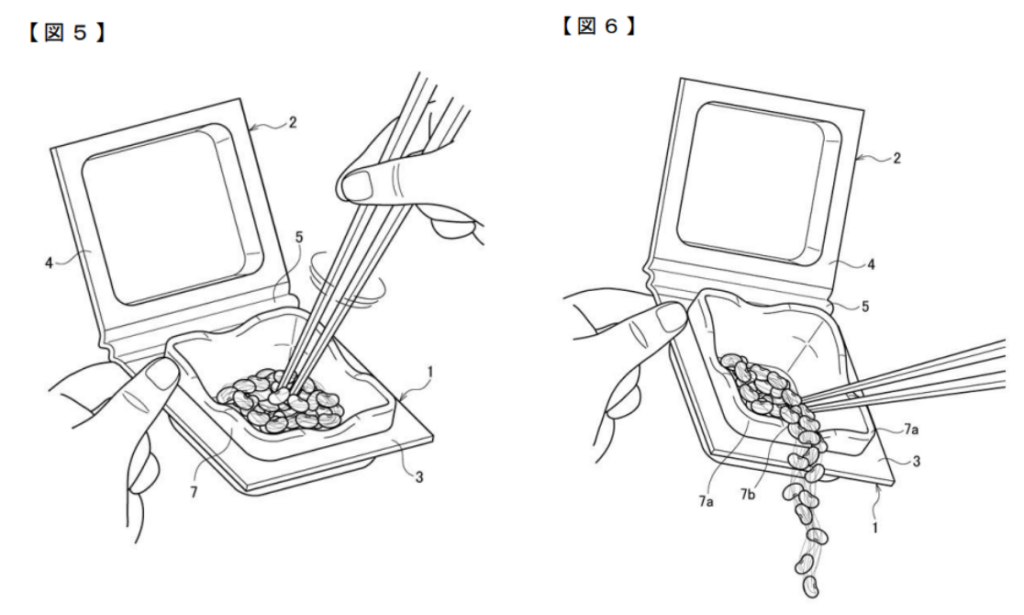
The diagram reveals a multi-functional natto container featuring:
- A recessed stirring chamber that limits splatter
- A built-in guide groove for chopsticks or a stirring tool
- A separating ridge that keeps natto in place while mixing
- A secondary compartment for sauce and mustard
- A serving corner designed to let natto slide smoothly onto rice
This structure turns the package itself into a stirring device.
How the Easy-Stirring Mechanism Works
The function is simple yet clever:
- The user moves chopsticks along a designated groove that stabilizes movement
- The chamber depth keeps threads contained
- Stirring inside the recessed area reduces mess and improves fermentation aeration
- When ready, natto can be tilted toward the serving corner
- A sloped surface helps transfer natto neatly onto rice
The pack guides the user toward a cleaner, faster mix.
Benefits for Everyday Consumers and Food Manufacturers
- Much less mess during stirring
- Cleaner transfer onto rice or plates
- Reduces packaging waste by eliminating the need for extra bowls
- Enhances natto’s appeal for children, seniors, and beginners
- Great for convenience stores, lunch kits, and take-home meals
A small design change with a big lifestyle impact.
Engineering & Food-Packaging Considerations
- Stirring groove must withstand pressure from chopsticks
- Material thickness must prevent deformation during mixing
- Interior coating needs to reduce stickiness
- Structural rigidity ensures clean serving angle
- Multi-compartment separation must remain sealed during transport
Packaging becomes part of the eating experience.
Patent Attorney’s Thoughts
Everyday foods deserve thoughtful design.
This invention turns a simple natto pack into a tool for comfort, efficiency, and a more pleasant morning ritual.
Application of the Technology: Autonomous Micro-Biome Cultivation and Dispersion Systems
Original Key Points of the Invention
- A natto package designed so that beans can be stirred easily without spilling.
- Structural features (angled walls, stirring grooves, or integrated pathways) guide the beans’ movement.
- The package also allows clean, easy serving after stirring.
- The invention integrates “stirring” and “dispensing” into a single controlled flow path.
Abstracted Concepts
- Designing a container that induces predictable flow behavior of small particles.
- Using geometry to control chaotic mixing.
- Creating a guided path that transitions from agitation to smooth dispensing.
- A system where “movement → transformation → output” occurs inside one vessel.
Transposition Target
- A self-contained micro-biome cultivation pod that automatically stirs, oxygenates, and then releases microorganisms or nano-particles in a controlled pattern.
Concrete Realization
A sealed cultivation pod contains micro-organisms, nutrients, and micro-beads.
Internal geometry guides agitation when the pod is shaken by a built-in actuator.
The grooves inside not only mix but also oxygenate the culture, shaping its growth.
When the pod reaches the target state, its channels open, releasing the culture into the environment as mist, patterns, or streams—useful for terraforming experiments, environmental seeding, or controlled nano-dispersion tests.
It functions as a “shake → grow → release” micro-ecosystem generator inspired directly by natto packaging.
↓Related drawing↓