

- Introduction: Why Visualizing Droplet Spread Matters
- What the Patent Drawing Shows About Droplet Dispersion
- How the Droplet Spread Mechanism Is Modeled
- Why Droplet Visualization Supports Public Health and Design
- Engineering and Scientific Considerations
- Patent Attorney’s Thoughts
- Application of the Technology: “Respiratory Droplet Visualization Platform”
- Final Reflections
Introduction: Why Visualizing Droplet Spread Matters
Understanding how droplets move during a cough is essential for public health, medical research, and product design.
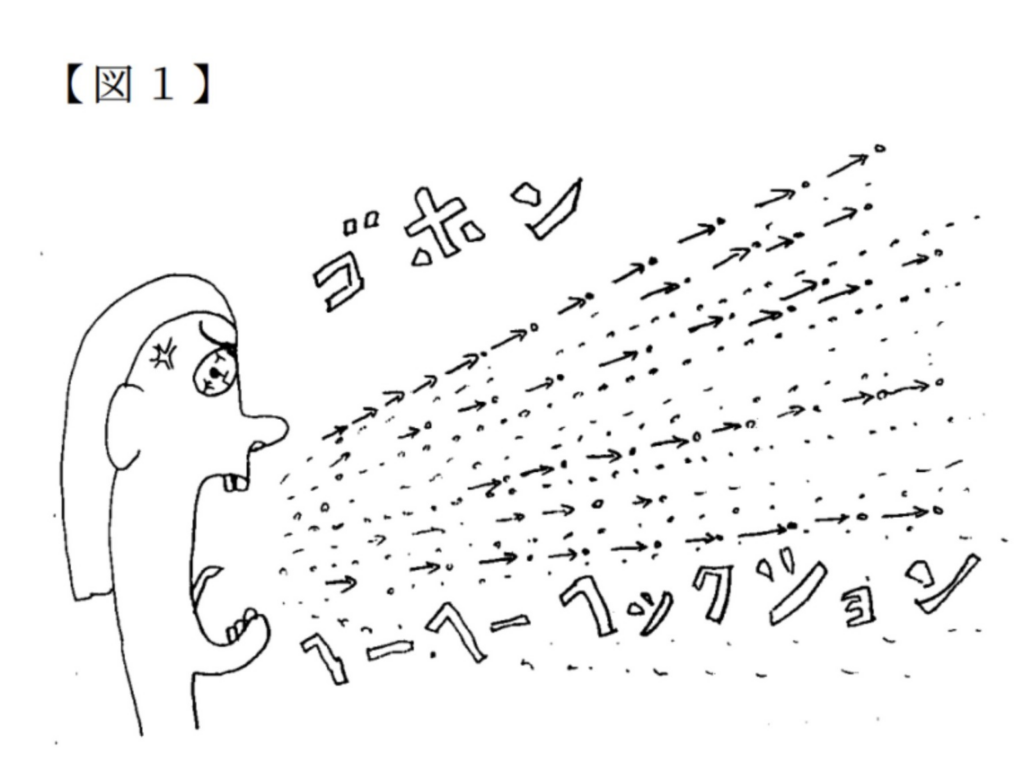
This patent drawing illustrates a detailed representation of cough-generated droplets,
providing insights into dispersion patterns, angles, and spread distance.
It turns an invisible process into a clear, observable phenomenon.
What the Patent Drawing Shows About Droplet Dispersion
The illustration presents several key elements:
- A side-view silhouette representing a coughing person
- The trajectory of droplets projected from the mouth
- Variations in droplet size and dispersal angle
- A cloud-like visualization of fine mist
- Distance indicators showing how far droplets can travel
This makes abstract aerosol behavior easier to interpret.
How the Droplet Spread Mechanism Is Modeled
The drawing organizes droplet movement through:
- Lines showing initial high-velocity droplets
- A widening dispersion cone illustrating spread angle
- Gradual reduction in size and density farther from the source
- Differentiation between large droplets (fall quickly) and fine aerosols (travel farther)
- A clear separation of zones: near-field and far-field exposure
This provides a visual framework for understanding infection risk.
Why Droplet Visualization Supports Public Health and Design
- Helps illustrate airborne transmission risks
- Supports mask design and airflow control research
- Aids educational materials on respiratory etiquette
- Useful for ventilation and air filtration engineering
- Assists in designing protective barriers or shields
Visual clarity leads to better prevention strategies.
Engineering and Scientific Considerations
Droplet modeling requires cross-disciplinary understanding:
- Fluid dynamics of respiratory emissions
- Influence of mouth shape and coughing force
- Environmental factors such as airflow, temperature, and humidity
- Particle size distribution
- Visualization methods that are easy for the public to interpret
The drawing simplifies complex phenomena without losing accuracy.
Patent Attorney’s Thoughts
There is a certain quiet power in diagrams that reveal the unseen.
By mapping the path of droplets, this design turns a momentary human action into a structured visual narrative.
It offers clarity in a space where understanding directly affects safety,
reminding us how illustration and science can work together to protect everyday life.
Application of the Technology: “Respiratory Droplet Visualization Platform”
Purpose
To visually model cough-generated droplets for use in health education, airflow engineering, and protective equipment design.
System Components
- Human silhouette reference
- Droplet trajectory lines
- Dispersion cone illustration
- Particle-size differentiation graphics
- Distance or exposure-zone indicators
Operational Flow
- A coughing event is represented through a modeled silhouette.
- Droplet trajectories are drawn from the mouth.
- The spread angle and density are illustrated as a dispersion cone.
- Exposure distance is marked.
- The diagram is used for education, design, or airflow analysis.
Final Reflections
This depiction of cough-related droplets shows how simple imagery can clarify public health concepts.
It transforms airflow science into an accessible visual tool.
Disclaimer: This content is an AI-generated reinterpretation based on a patent drawing.
It is provided for educational and cultural purposes only, and not as legal advice.
↓Related drawing↓