
In this article, we introduce a patent related to snack preparation with instructional packaging, focusing on how step-by-step guidance and packaging design are translated into a clear and technically structured solution.
- Introduction: Packaging That Teaches You How to Make the Snack
- What the Patent Drawing Reveals About the Instructional Packaging
- How the Snack-Preparation Mechanism Works
- Benefits for Consumers, Food Brands, and Educational Design
- Engineering and Food-Safety Considerations
- Patent Attorney’s Thoughts
- Application of the Technology: Self-Teaching Edible Process Interfaces and Autonomous Culinary Narrative Systems
Introduction: Packaging That Teaches You How to Make the Snack
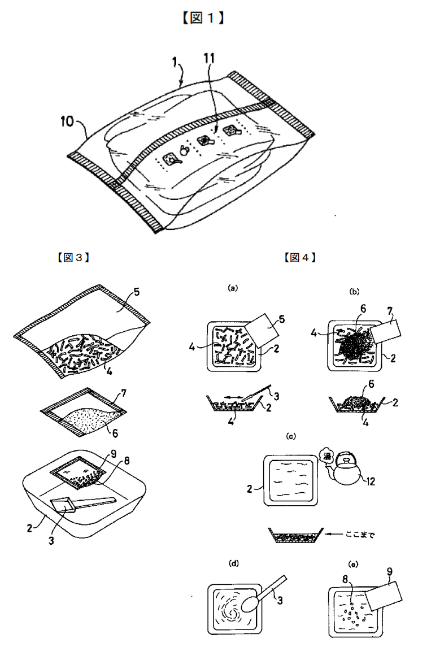
Some snacks don’t just come ready-to-eat—sometimes the preparation process is part of the fun. This patent drawing introduces packaging that directly guides the user through snack preparation, integrating clear illustrations and structural cues into the packaging itself.
What the Patent Drawing Reveals About the Instructional Packaging
The diagram showcases a packaging system that doubles as a step-by-step guide:
- Printed instructional graphics placed in sequential order
- Lines, arrows, or fold marks showing how to handle ingredients
- Portions of the package that open to reveal additional steps
- Integrated compartments for different snack components
- Visual cues guiding mixing, pouring, or shaping
The packaging becomes both container and teacher.
How the Snack-Preparation Mechanism Works
The user follows the diagram without needing an external recipe:
- Open the package along marked lines
- Access the ingredients in separate compartments
- Follow arrows showing mixing or assembly steps
- Use built-in structural guides such as folds or pour spouts
- Complete the snack using only the package instructions
The process feels intuitive—almost like following a comic.
Benefits for Consumers, Food Brands, and Educational Design
- Makes snack preparation accessible and fun
- Reduces the need for written instructions
- Ideal for children, tourists, and visual learners
- Enhances brand identity through interactive packaging
- Suitable for DIY snacks, seasonal products, or novelty foods
It blends convenience with playful learning.
Engineering and Food-Safety Considerations
Key considerations include:
- Food-safe printing and ink placement
- Moisture-resistant barriers between compartments
- Easy-tear lines that remain secure until opened
- Clear visibility of instructions under various lighting
- Structural rigidity for stable preparation
Packaging design must remain hygienic and intuitive.
Patent Attorney’s Thoughts
Packaging becomes a guide, and eating becomes a small journey.
By embedding instructions directly into the package, this invention turns a simple snack into an experience of discovery and delight.
Application of the Technology: Self-Teaching Edible Process Interfaces and Autonomous Culinary Narrative Systems
Original Key Points of the Invention
- Snack packaging contains printed or structural instructions that guide the user through the preparation process.
- The packaging itself may fold, open, or align in ways that physically demonstrate steps.
- Visual cues, diagrams, or segmented compartments show ingredient order.
- The package functions as both container and instructional interface.
Abstracted Concepts
- Embedding process knowledge into physical objects.
- Turning packaging into a self-explanatory, step-sequencing interface.
- Using spatial arrangement to communicate procedural flow.
- A hybrid object that is simultaneously “tool,” “guide,” and “container.”
Transposition Target
- Autonomous “self-teaching objects” that instruct users in complex tasks—emotional, cognitive, or technical—through physical transformation or contextual signals.
Concrete Realization
A foldable object (toy, tool, or wearable) contains embedded motion cues.
When unfolded in certain ways, it teaches meditation sequences; folded differently, it guides breathing; twisted into another configuration, it reveals conflict-resolution guidance or creative brainstorming paths.
The object becomes a procedural companion: a shape-shifting artifact that teaches life skills through its own transformations.
Snack instruction packaging becomes a blueprint for “physical artifacts that teach you how to use your mind.”
↓Related drawing↓