
Related Item:BIG CLAPPER -The Clapping Robot-
In this article, I introduce a patent related to a robot capable of clapping above its head, focusing on how motion control and mechanical coordination are translated into a technically structured and engaging robotic design.
- Introduction: A Playful Robot with Expressive Overhead Clapping
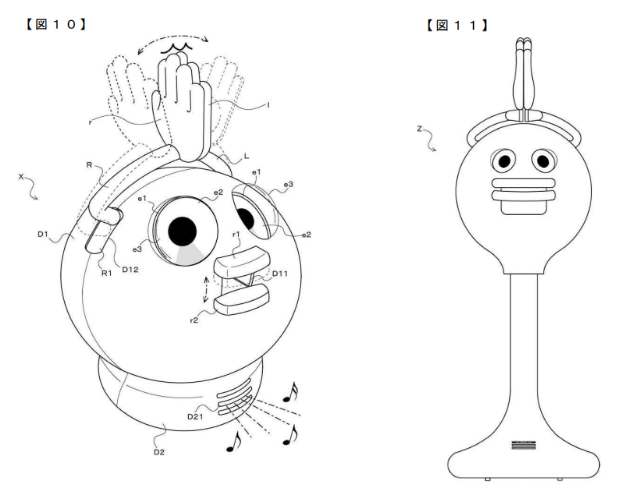
- What the Patent Drawing Shows
- How the Overhead Clapping Mechanism Works
- Benefits for Entertainment, Events, and Human–Robot Interaction
- Engineering & Motion-Control Considerations
- Patent Attorney’s Thoughts
- Application of the Technology: Urban Mood Regulation Sector
Introduction: A Playful Robot with Expressive Overhead Clapping
This patent introduces a robot designed to clap its hands above its head.
The gesture resembles cheering, celebrating, or encouraging an audience.
By enabling upward arm extension and stable overhead clapping, the robot becomes both expressive and entertaining.
It blends mechanical engineering with character-like motion to support amusement, interaction, and event staging.
What the Patent Drawing Shows
The diagram illustrates a humanoid robot equipped with long articulated arms.
Its shoulder joints feature extended rotation capability to allow hands to meet above the head.
The elbow joints bend inward while maintaining structural balance.
Sensors guide the synchronization of both hands for accurate clapping rhythm.
A stabilized lower body prevents wobbling as the arms move upward.
The robot’s head remains unobstructed, ensuring clear visibility and expressive motion.
How the Overhead Clapping Mechanism Works
The robot begins by lifting its arms with controlled torque.
Rotational shoulder motors allow the arms to fully rise past ear level.
Elbow servos adjust the angle so the palms can align correctly.
A dedicated clapping actuator moves each hand toward the other with rhythmic timing.
Impact sensors detect when the hands meet and adjust force to maintain consistent sound.
The system repeats this motion while keeping the robot’s balance through lower-body correction.
Benefits for Entertainment, Events, and Human–Robot Interaction
Overhead clapping creates a clearer, more visible gesture than chest-level clapping.
This makes the robot ideal for concerts, sporting events, theme parks, and stage performances.
The gesture helps convey encouragement, celebration, and audience engagement.
Children and adults alike respond positively to expressive robotic motions.
The mechanism also supports teaching robots emotional signaling and body-language communication.
Engineering & Motion-Control Considerations
Shoulder joints require expanded rotational freedom without compromising durability.
Arms must remain lightweight to reduce motor strain.
Hand alignment accuracy is essential to produce audible, consistent claps.
Center-of-gravity adjustments must prevent tipping during overhead movement.
Heat protection is required for motors performing repeated lifts.
All structural parts must withstand impact from repetitive clapping.
Patent Attorney’s Thoughts
Emotion lives in movement, and movement lives in design.
By raising its hands and clapping above its head, this robot expresses joy in a way that feels unexpectedly human.
Application of the Technology: Urban Mood Regulation Sector
Original Key Points of the Invention
- A robot capable of clapping above its head, with an extended range of motion.
- Highly flexible shoulder and elbow joints enabling expressive, celebratory gestures.
- Precisely synchronized bilateral arm movements that produce rhythmic patterns.
- Ability to communicate emotion through a physical gesture such as clapping.
Abstracted Concepts
- Motion interface that exceeds typical biomechanical limits.
- Emotional signaling through body movement.
- Environmental modulation using synchronized rhythm.
- Communication enabled by physical gesture patterns.
Transposition Target
- A giant robotic mood-regulation system that adjusts the emotional atmosphere of an entire city using overhead clapping rhythms.
Concrete Realization
A large robot is installed in the center of a city.
An emotion-sensing AI continuously analyzes crowd sentiment.
The robot changes the frequency, strength, and amplitude of its overhead clapping.
Its rhythm synchronizes with city lighting, airflow systems, and ambient audio.
Through this rhythmic alignment, the robot gradually tunes the collective emotional tone of the urban environment, functioning as an emotional metronome.
↓Related drawing↓