
In this article, we introduce a patent related to a hands-free umbrella system with a body harness, focusing on how ergonomic considerations and mechanical support are translated into a technically structured and practical device design.
- Introduction: Why Hands-Free Umbrellas Improve Everyday Mobility
- What the Hands-Free Umbrella System Includes
- How the Body-Harness Umbrella Mechanism Works
- Practical Advantages in Real-World Use
- Engineering Challenges and Ergonomic Considerations
- Patent Attorney’s Thoughts
- Application of the Technology: Body-Anchored Environmental Shielding and Personal Climate Orchestration Systems
Introduction: Why Hands-Free Umbrellas Improve Everyday Mobility
Traditional umbrellas demand constant handling, restrict movement, and make rainy days more inconvenient.
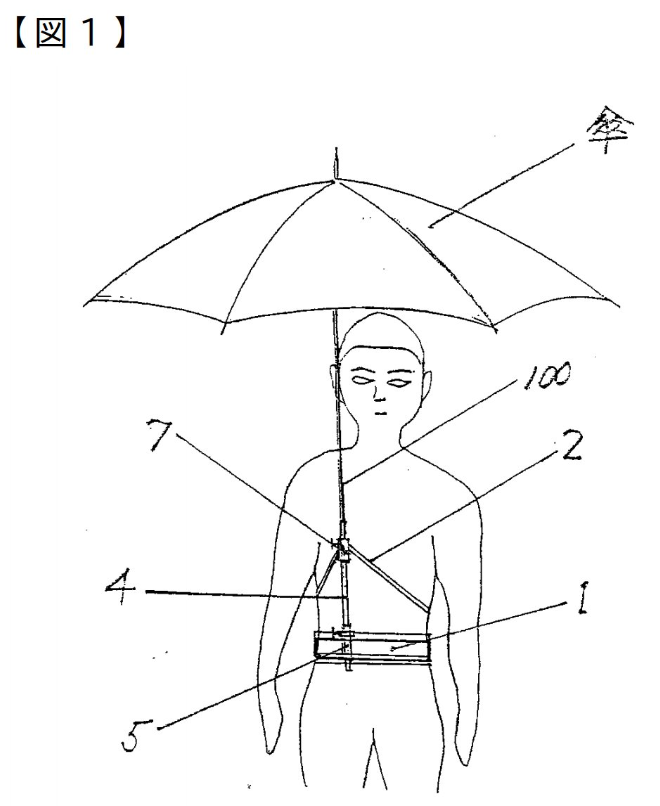
This patent drawing introduces a hands-free umbrella system mounted onto a body harness, enabling users to stay protected from rain without using their hands.
It blends ergonomics, mobility, and practical design into a wearable rain-shield system.
What the Hands-Free Umbrella System Includes
The patent illustration shows a well-integrated wearable mechanism featuring:
- A torso-fitted harness that anchors the umbrella
- A mounting bracket that securely holds the umbrella pole
- Adjustable shoulder and waist straps for sizing
- A wind-stabilizing mechanism to prevent rotation or wobble
- An umbrella position set slightly behind the user for clear visibility
This turns rain protection into a hands-free, body-supported tool.
How the Body-Harness Umbrella Mechanism Works
The umbrella pole connects to the harness through a mechanical bracket designed for stability.
As the user walks, the harness distributes weight evenly across the torso, preventing strain on the neck or arms.
Because the umbrella sits behind the user’s head, it shields rain while preserving an unobstructed field of view.
The system adapts naturally to walking speed, arm movement, and daily activities.
Practical Advantages in Real-World Use
- Hands remain free for bags, strollers, tools, or smartphones
- Stable in motion—ideal for commuting, working outdoors, or caregiving
- Reduces arm fatigue compared to holding an umbrella
- Useful in scenarios where both hands must be available
- Enhances safety by maintaining clear vision during movement
This wearable design transforms rain protection into a mobility-enhancing device.
Engineering Challenges and Ergonomic Considerations
Creating a comfortable and stabilizing wearable structure involves several engineering hurdles:
- Wind resistance must not tilt or twist the umbrella
- Straps must allow natural shoulder and torso movement
- Weight distribution requires careful balancing
- The design must be adjustable for various body shapes
- Attachment points must avoid causing pressure or discomfort
Behind the simple appearance lies precise ergonomic thought.
Patent Attorney’s Thoughts
This invention feels like a quiet improvement to daily life—small in appearance, but meaningful in impact.
By shifting an umbrella from the hand to the body, the design gives the user freedom of movement, allowing ordinary actions to continue uninterrupted.
What stands out is the sensitivity to human motion: the recognition that rain shouldn’t force us to choose between staying dry and keeping our hands free.
Innovation sometimes means rethinking familiar tools so they align more closely with how we naturally live and move.
Application of the Technology: Body-Anchored Environmental Shielding and Personal Climate Orchestration Systems
Original Key Points of the Invention
- An umbrella system fixed to the body using a harness, allowing hands-free use.
- The umbrella maintains position relative to the user’s body during movement.
- Frees both hands while providing continuous protection from rain or sunlight.
- Improves mobility, safety, and task performance in bad weather.
Abstracted Concepts
- Anchoring environmental protection directly to the human body.
- Decoupling protection devices from hand-based control.
- Treating the human body as the central reference frame for environmental interfaces.
- Continuous, posture-following shielding during motion.
Transposition Target
- A body-centered personal climate orchestration system that dynamically manages rain, wind, light, sound, and airborne stimuli around an individual.
Concrete Realization
The harness evolves into a lightweight exoskeletal frame.
Instead of a simple umbrella, a flexible canopy of micro-panels surrounds the upper body.
The system senses wind direction, rainfall intensity, sunlight angle, and noise levels.
Panels subtly reorient to block rain, diffuse harsh light, or dampen sound.
In crowded cities, it creates a personal “micro-weather bubble”;
in extreme environments, it becomes a mobile survival shell.
The hands-free umbrella transforms into a body-anchored climate interface,
where the human moves freely while the environment is continuously reshaped around them.
↓Related drawing↓