

In this article, we introduce a patent related to an interactive Mario character with facial expression control, focusing on how the concept of facial interaction is translated into a technically defined structure.
- Introduction: Bringing Mario to Life Through Facial Expression Control
- What the Patent Drawing Reveals About the Expression System
- How the Expression-Control Mechanism Works
- Benefits for Games, Communication Apps, and Educational Tools
- Technical and UX Considerations
- Patent Attorney’s Thoughts
- Application of the Technology: Emotion-Programmable Character Avatars and Reality-Responsive Expression Interfaces
Introduction: Bringing Mario to Life Through Facial Expression Control
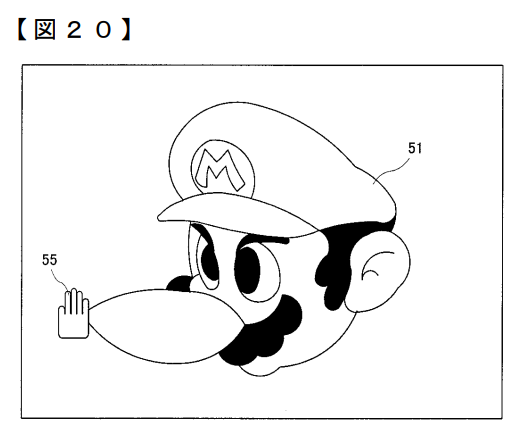
Mario’s iconic expressions—smiling, determined, surprised—are core to his charm. This patent drawing reimagines Mario’s expressiveness through user-controlled facial animations, allowing players to adjust Mario’s emotions directly via interface elements or device gestures.
What the Patent Drawing Reveals About the Expression System
The diagram outlines a structured interaction model for changing Mario’s face:
- A Mario character model with multiple facial expression presets
- UI sliders or buttons linked to facial movements
- Regions on the face (eyes, eyebrows, mouth) mapped to individual controls
- A preview window where Mario reacts instantly
- Optional motion or touch-based expression manipulation
This transforms Mario from a static character into an interactive emotional avatar.
How the Expression-Control Mechanism Works
The system allows real-time adjustments using intuitive controls:
- Users tap or slide on UI elements to adjust Mario’s mood
- Each facial component (eyes, eyebrows, mouth) responds independently
- Combined adjustments create countless emotional variations
- Sensor input (tilt, touch, voice) may trigger automatic reactions
- Expressions can be saved or used in gameplay, animation scenes, or communication apps
Players essentially “direct” Mario’s performance.
Benefits for Games, Communication Apps, and Educational Tools
- Enhances user immersion by adding emotional depth
- Ideal for cutscenes or storytelling within games
- Supports social applications such as reaction stickers or avatar chats
- Useful for children’s apps emphasizing emotional learning
- Strengthens brand engagement by making Mario feel more alive
Emotion becomes a new layer of interaction.
Technical and UX Considerations
Key design points include:
- Smooth blending transitions between facial states
- Maintaining Mario’s iconic look while allowing expressive variation
- Easy-to-use controls for young players
- Hardware responsiveness to ensure real-time feedback
- Preventing uncanny distortions through preset limits
Expressiveness must feel both fun and familiar.
Patent Attorney’s Thoughts
Characters become unforgettable when they share emotion.
Giving users control of Mario’s expressions bridges play and performance—turning interaction into storytelling.
Application of the Technology: Emotion-Programmable Character Avatars and Reality-Responsive Expression Interfaces
Original Key Points of the Invention
- A Mario character figure whose face can change expressions (smile, blink, surprise).
- Sensors detect user interactions: touch, movement, voice, or proximity.
- The character reacts with expressive facial animations and simple behaviors.
- Creates emotional engagement through real-time interactive expression.
Abstracted Concepts
- Using facial expression as a primary communication interface.
- Mapping external stimuli to emotionally meaningful expression shifts.
- Characters as mirrors of user actions, moods, or context.
- Embedding emotional responsiveness into physical avatars.
Transposition Target
- A network of “emotion-programmable avatars” whose faces transform based on environmental states, interpersonal dynamics, or collective emotional atmosphere.
Concrete Realization
A group of physical avatars—small figurines, desk companions, wearable badges—share an emotional network.
When a room becomes tense, their expressions soften to encourage calm;
when creativity rises, they display playful smirks or curious tilts;
during social bonding moments, they beam with warm smiles.
They become tiny emotional satellites that sense the collective mood and respond with expressive micro-gestures,
forming a distributed emotional ecosystem:
a world where expression-enabled figurines help humans read, reflect, and harmonize emotions.
↓Related drawing↓