
- Introduction: Why Reimagine a Hamburger as a Skewered Structure?
- What the Patent Drawing Reveals About the Layered Structure
- How the Skewered Assembly Mechanism Works
- Benefits for Food Vendors, Events, and Home Cooking
- Engineering / Culinary Design Considerations
- Patent Attorney’s Thoughts
- Application of the Technology: “Vertical Layered Food Assembly Platform”
- Final Reflections
Introduction: Why Reimagine a Hamburger as a Skewered Structure?
Hamburgers are iconic, but their portable format isn’t always optimal. This patent drawing introduces a skewered hamburger with vertically layered components, offering a neat, structured, and surprising take on a classic dish. By placing each ingredient on a skewer, the design enhances portability, assembly control, and visual appeal.
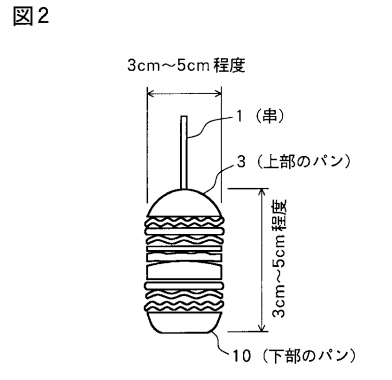
What the Patent Drawing Reveals About the Layered Structure
The illustration highlights:
- A vertical skewer running through all components
- Stacked layers such as bun, lettuce, patty, cheese, and tomato
- A stabilizing base or serving tray
- Ingredient spacing that prevents sliding
- Controlled compression for consistent presentation
The structure turns a normally horizontal food into a vertical, organized form.
How the Skewered Assembly Mechanism Works
The skewered design provides stability and usability:
- Ingredients are threaded onto a central skewer
- Layer compression prevents shifting during eating
- The shape allows for uniform heating or grilling
- The top/bottom anchors secure all components
- Easy to assemble at home or in food stalls
This inventively restructures a familiar dish for new contexts.
Benefits for Food Vendors, Events, and Home Cooking
- Highly portable for outdoor events or street food
- Less mess—layers don’t slip like traditional burgers
- Visually appealing, ideal for themed cafés or bento
- Allows creative ingredient combinations
- Simplifies storage, serving, and even reheating
It transforms the humble burger into a structured, photogenic meal.
Engineering / Culinary Design Considerations
- Skewer strength and food-safe materials
- Layer thickness to maintain structural balance
- Heat distribution when grilling vertically
- Preventing ingredient tearing during skewering
- Ergonomic serving tray or holder
Food design meets functional engineering.
Patent Attorney’s Thoughts
Sometimes a small shift—horizontal to vertical—creates an entirely new eating experience.
This invention celebrates structure, showing that even comfort food can be redesigned with clarity and playfulness.
Application of the Technology: “Vertical Layered Food Assembly Platform”
Purpose
To stabilize hamburger components by stacking them on a central skewer.
System Components
- Central food-safe skewer
- Layered ingredient modules
- Top/bottom anchors
- Serving tray or stabilizer
- Optional heating/pressing fixture
Operational Flow
- Thread ingredients onto skewer.
- Compress to stabilize.
- Grill or serve vertically.
- Maintain structural alignment during eating.
- Remove skewer after consumption if desired.
Final Reflections
This invention reframes a familiar dish—turning the burger into a vertical culinary sculpture.
Disclaimer: This content is an AI-generated reinterpretation based on a patent drawing.
It is provided for educational and cultural purposes only, and not as legal advice.
↓Related drawing↓