In this article, we introduce a patent related to a method for wearing a kimono like a dress, focusing on how traditional clothing concepts and practical usability considerations are translated into a technically structured and accessible wearing procedure.
- Introduction: Transforming Tradition into Contemporary Fashion
- What the Patent Drawing Shows
- How the Dressing Transformation Works
- Benefits for Fashion, Tourism, and Daily Use
- Clothing-Design & Human-Movement Considerations
- Patent Attorney’s Thoughts
- Application of the Technology: Adaptive Cultural Morphing Garment Systems
Introduction: Transforming Tradition into Contemporary Fashion
Kimono dressing is intricate and elegant, yet sometimes impractical for modern daily life. This patent drawing presents a method for wearing a kimono like a Western-style dress, allowing the garment to retain its iconic silhouette while gaining ease of movement and simplified wearing steps.
What the Patent Drawing Shows
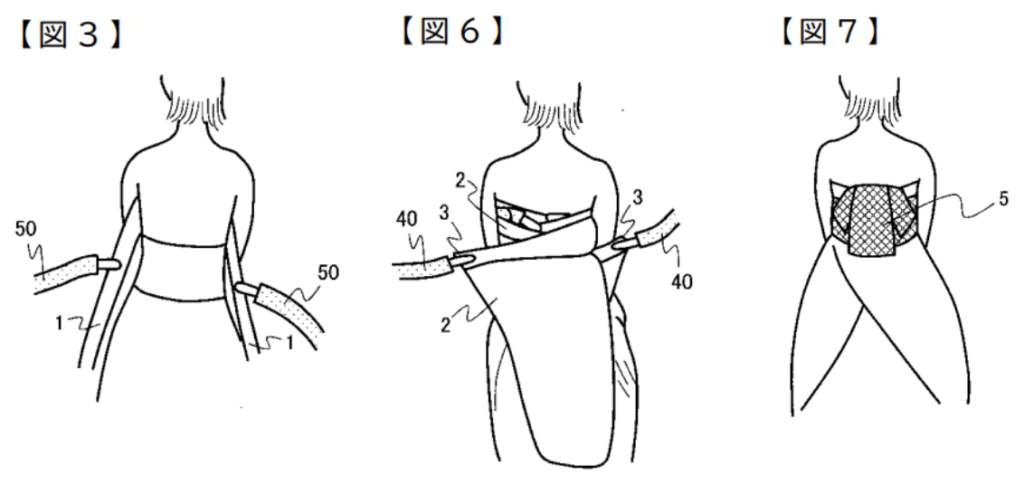
The diagrams highlight a structured technique that reshapes kimono fabric lines into dress-like contours:
- A wrapping sequence that creates a defined waistline
- Adjusted hem alignment for ease of walking
- A modified obi placement that resembles a belt
- Functional tucks and folds to stabilize the form
- A silhouette that blends traditional kimono flow with dress usability
The method modernizes kimono wearing without altering the garment itself.
How the Dressing Transformation Works
The wearer places the kimono normally, then:
- Wraps the front panels diagonally to create a dress-like overlap
- Cinches the waist using a modified obi or belt-style tie
- Adjusts the lower hem to maintain mobility
- Folds excess fabric inward for a clean, fitted appearance
- Secures the structure so the “dress mode” retains shape during movement
This allows the kimono to function as both cultural attire and fashion wear.
Benefits for Fashion, Tourism, and Daily Use
- Makes kimono wearing more accessible for beginners
- Ideal for modern events, casual outings, and photo shoots
- Enhances mobility while preserving traditional beauty
- Encourages kimono use beyond ceremonial occasions
- Supports tourism experiences by simplifying dressing steps
A balance of elegance, comfort, and practicality.
Clothing-Design & Human-Movement Considerations
- Fold directions must maintain kimono fabric integrity
- Belt tension must be comfortable yet secure
- Hem management is crucial for safe walking
- Fabric weight influences drape and dress-like silhouette
- The structure must not constrain arm movement
Traditional tailoring meets wearable design.
Patent Attorney’s Thoughts
Clothing lives between culture and comfort. This invention shows how tradition can adapt—not by erasing its identity, but by evolving into new modes of expression.
Application of the Technology: Adaptive Cultural Morphing Garment Systems
Original Key Points of the Invention
- A method for wearing a kimono in a dress-like manner without losing its essential form.
- Specific folding, wrapping, or tension-balancing techniques enable stable wearing.
- The design allows movement and comfort while preserving traditional silhouette elements.
- A hybrid dressing procedure that merges cultural attire with modern practicality.
Abstracted Concepts
- Transforming a traditional structure into a new functional mode through procedural adaptation.
- Using folding logic and tension distribution to morph shapes.
- Making a garment switch between two identities depending on how it is arranged.
- Procedural reconfiguration as a method of cultural reinterpretation.
Transposition Target
- A self-morphing garment system that dynamically shifts form—kimono, dress, cloak, armor-like structure—based on context, activity, or environmental input.
Concrete Realization
A garment is embedded with shape-memory fibers and adjustable tension rails.
When the wearer selects “mode,” micro-actuators shift the garment’s folds, redistribute tension, and reposition panels.
The same cloth becomes a formal kimono, a flowing dress, a travel cloak, or a protective silhouette depending on need.
Cultural forms become modular states within a single textile entity, giving the wearer a wardrobe that adapts itself like a living organism.
↓Related drawing↓