

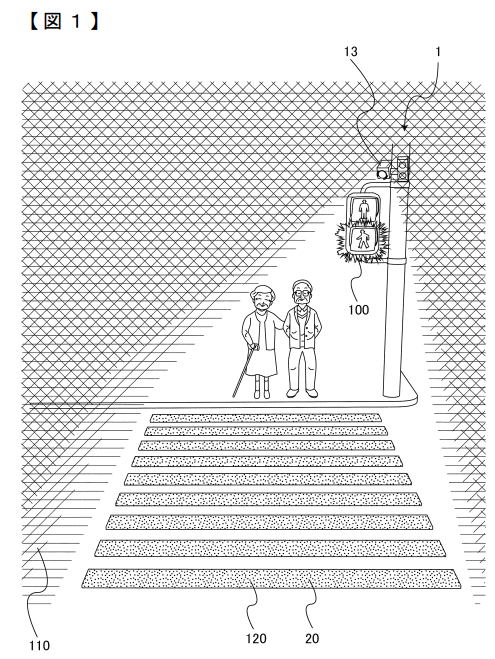
In this article, we introduce a patent related to a pedestrian traffic signal system with enhanced visibility for elderly individuals, focusing on how the design addresses the needs of aging pedestrians and translates those considerations into a technically structured invention.
- Introduction: Designing Crosswalk Signals for Aging Communities
- What the Patent Drawing Reveals About the Visibility-Focused Design
- How the Elderly-Friendly Guidance Mechanism Works
- Benefits for Urban Planning, Public Safety, and Community Design
- Engineering and Human-Factors Considerations
- Patent Attorney’s Thoughts
- Application of the Technology: Perceptual-State Adaptive Urban Signaling and Emotion-Sensitive Mobility Guidance Systems
Introduction: Designing Crosswalk Signals for Aging Communities
As global populations age, pedestrian safety becomes an increasingly urgent public concern. This patent drawing proposes a pedestrian traffic signal system optimized for elderly users, featuring visibility-enhancing graphics, enlarged icons, and supportive guidance cues.
What the Patent Drawing Reveals About the Visibility-Focused Design
The diagram illustrates a redesigned crosswalk signal that prioritizes clarity and accessibility:
- An enlarged “Walk / Don’t Walk” pictogram
- High-contrast outlines for enhanced visibility
- A countdown timer displayed with bold, easy-to-read numerals
- Supplemental arrows indicating direction
- A background panel that reduces glare and visual noise
Every component reinforces legibility under varied conditions.
How the Elderly-Friendly Guidance Mechanism Works
The system provides multiple supportive cues simultaneously:
- Large icons reduce cognitive load during crossing decisions
- High-brightness LEDs ensure visibility under sunlight
- The countdown timer communicates remaining crossing time
- Directional arrows help users orient themselves
- Optional audio output assists those with vision limitations
The design supports slower reaction times and improves safety.
Benefits for Urban Planning, Public Safety, and Community Design
- Enhances safety for elderly pedestrians and mobility-impaired individuals
- Reduces crossing hesitation and accidents at busy intersections
- Supports universal design principles
- Improves accessibility for tourists and non-native speakers
- Promotes safer mixed-use city environments
A small visual improvement can have major societal impact.
Engineering and Human-Factors Considerations
Key design points include:
- Optimal icon size for long-distance visibility
- LED brightness scaling based on weather
- Anti-glare surface treatments
- Intuitive and universally recognizable symbols
- Durability for outdoor urban environments
Both technical design and human psychology shape the system.
Patent Attorney’s Thoughts
Safety grows where clarity lives.
This invention recognizes the subtle challenges of aging and reshapes everyday infrastructure so every person—young or old—can cross the street with confidence.
Application of the Technology: Perceptual-State Adaptive Urban Signaling and Emotion-Sensitive Mobility Guidance Systems
Original Key Points of the Invention
- A pedestrian signal system designed to improve visibility for elderly individuals.
- Enlarged icons, stronger contrast, extended lighting angles, and clearer timing indications.
- The system compensates for age-related visual decline such as reduced contrast sensitivity and narrower vision fields.
- Enhances pedestrian safety through perceptual adjustability.
Abstracted Concepts
- Adjusting environmental signals to match the perceptual capacity of different individuals or groups.
- Turning public signals into adaptive interfaces that change based on user needs.
- Using visual modulation to regulate movement, timing, and behavioral safety.
- Embedding human-centered sensing into urban infrastructure.
Transposition Target
- A city-wide adaptive signaling system where crosswalks, signs, and ambient indicators respond dynamically to emotional, cognitive, or physiological states—guiding mobility through shifts in color, pattern, light rhythm, or spatial cues.
Concrete Realization
Pedestrian pathways become “emotion-sensitive corridors.”
If a pedestrian is anxious, the ground lights widen and glow warm to encourage steady walking.
If someone is distracted, directional cues sharpen and pulse slowly to reorient attention.
For those experiencing fatigue, crossing durations extend automatically as sensors detect slowed gait patterns.
The city becomes a living guide:
a network of adaptive signals that tune themselves to each person’s perceptual and emotional state,
transforming urban movement into a gentle, responsive dialogue between human and environment.
↓Related drawing↓