
- Introduction: Why Design a Cat Harness with Multi-Layer Adjustable Straps?
- What the Patent Drawing Reveals About the Harness Structure
- How the Adjustable Harness Mechanism Works
- Benefits of a Cat-Optimized Adjustable Harness
- Engineering Considerations
- Patent Attorney’s Thoughts
- Application of the Technology: “Adaptive Feline Mobility-Support Harness”
- Final Reflections
Introduction: Why Design a Cat Harness with Multi-Layer Adjustable Straps?
Cats are agile, flexible animals—notoriously difficult to secure safely with standard harnesses. Traditional dog-style harnesses often fail to match a cat’s body shape or escape tendencies. This patent drawing presents a cat-specific harness featuring multiple adjustable straps, engineered to improve comfort, prevent escape, and maintain natural movement while ensuring safe control during outdoor walks or vet visits.
What the Patent Drawing Reveals About the Harness Structure
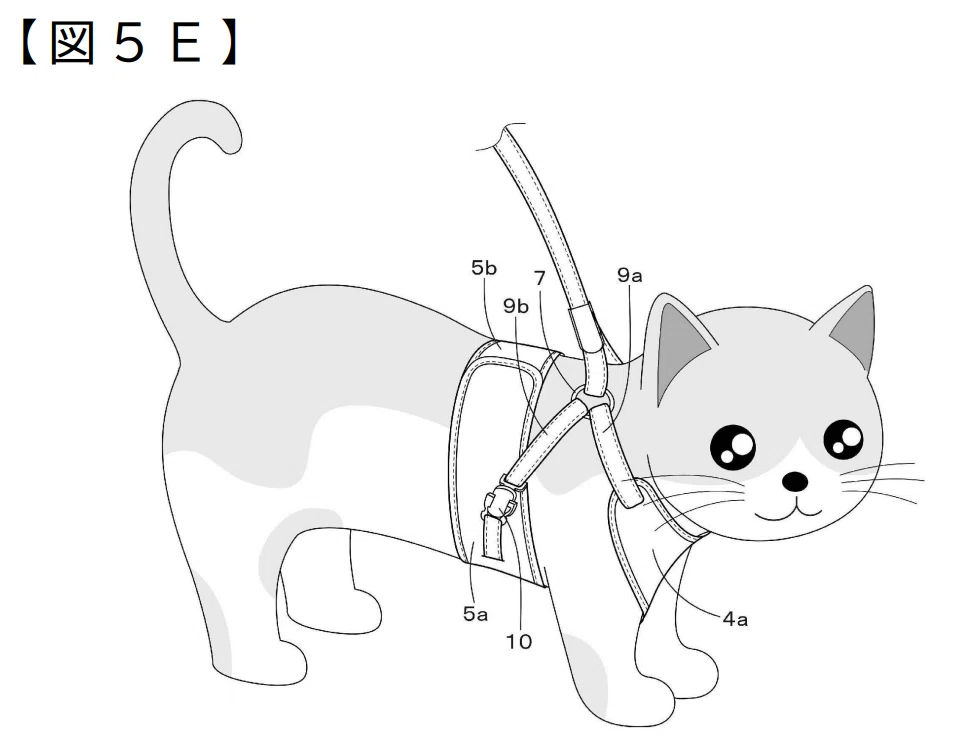
The illustration highlights a thoughtfully crafted structure:
- Multiple adjustable straps sized for feline anatomy
- A torso-wrapping configuration that distributes pressure safely
- A secure chest loop preventing forward slipping
- A back-mounted connection point for a leash
- Buckles or sliders for precise length adjustment
The design balances security with feline mobility.
How the Adjustable Harness Mechanism Works
The mechanism supports both fit and safety:
- Straps encircle the cat’s torso and shoulders
- Each strap length can be adjusted to match the cat’s size
- A chest loop prevents backing out of the harness
- The rear attachment point ensures even pull distribution
- Flexible strap materials allow natural gait and turning
This reduces escape risk while maintaining comfort.
Benefits of a Cat-Optimized Adjustable Harness
- Prevents escape by fitting cats’ unique body shape
- Distributes pressure across the torso, not the neck
- Reduces stress during outdoor walks
- Adjustable for different breeds, sizes, or weight changes
- Useful for training, harness-walking, or controlled exploration
It provides a safer alternative to collars or dog-style harnesses.
Engineering Considerations
Key design factors include:
- Strap material softness and durability
- Breathability for long-duration wear
- Slip-resistant buckles
- Long-term stability under feline movement
- Design contours accommodating shoulder rotation
Feline ergonomics dictate the final form.
Patent Attorney’s Thoughts
Cats resist constraint, yet they also require protection when stepping into the world.
This harness respects their nature—firm where it must be, flexible where it matters.
It is an elegant example of design shaped by empathy: keeping a creature safe without diminishing its independence.
Application of the Technology: “Adaptive Feline Mobility-Support Harness”
Purpose
To create a secure, comfortable harness tailored to feline anatomy, minimizing escape risk while supporting natural movement.
System Components
- Adjustable torso straps
- Chest-front stabilizing loop
- Shoulder-fitting strap geometry
- Rear leash-connection point
- Buckles or sliding adjusters
Operational Flow
- Adjust strap lengths to match the cat’s body.
- Wrap and secure the harness around torso and chest.
- Attach the leash to the rear connector.
- Ensure straps allow natural gait and rotation.
- Use for walking, transport, or controlled exploration.
Final Reflections
This design brings structure to a famously unstructured animal—guiding safety through gentle, adaptable support.
Disclaimer: This content is an AI-generated reinterpretation based on a patent drawing.
It is provided for educational and cultural purposes only, and not as legal advice.
↓Related drawing↓