

This article is written and reviewed by a Japanese patent attorney with professional experience in analyzing patent documents and technical drawings.
Through this site, I explore Japanese patent drawings not only as legal materials, but also as creative expressions of engineering ideas and inventive thinking.
In this article, I introduce and interpret a patent related to a Plarail coupling mechanism for smooth and stable train connection, focusing on how mechanical link design and functional stability are translated into a technically structured and reliable connection mechanism.
- Overview of the Patent Drawing
- Patent Insight 1: Guided Alignment for Effortless Connection
- Patent Insight 2: Dual Coupling System for Stability
- Patent Insight 3: Safety and Durability in Child-Oriented Engineering
- Keywords
- Patent Attorney’s Thoughts
- Application of the Technology: Dynamic Modular Connection Ecosystems and Adaptive Interlocking Networks
Overview of the Patent Drawing
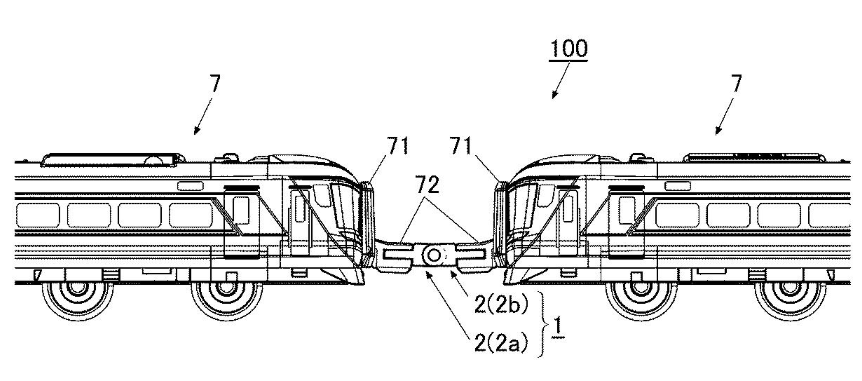
This patent drawing illustrates a Plarail train coupling system (100), designed to connect two toy trains (7) smoothly and securely.
The diagram shows two facing car bodies, each equipped with coupling components (2a, 2b) extending from the front ends.
At the center is the joint structure (72), flanked by guide arms (71) that ensure proper alignment during connection.
The mechanism enables two train cars to link effortlessly—even when slightly misaligned—while maintaining stability during motion.
This design reflects Plarail’s engineering ethos: making mechanical precision feel effortless and child-friendly.
Patent Insight 1: Guided Alignment for Effortless Connection
The guide arms (71) help the couplers self-align when the trains approach one another, reducing friction and misalignment.
This ensures that even a gentle push results in a perfect connection, embodying the tactile satisfaction that defines the Plarail experience.
Patent Insight 2: Dual Coupling System for Stability
The coupling elements (2a, 2b) form a dual-lock structure, distributing mechanical stress evenly across both cars.
This prevents detachment when the train moves on curves or inclines—achieving a smooth, continuous motion even under dynamic play conditions.
Patent Insight 3: Safety and Durability in Child-Oriented Engineering
Beyond mechanical function, this invention reflects careful human-centered design.
The rounded coupler edges and flexible joint (72) ensure safety while preventing wear.
It’s a subtle balance of robustness and simplicity—a hallmark of the Plarail system’s design philosophy since its inception.
Keywords
Plarail, toy train, coupling system, connection mechanism, guided alignment, dual coupler, Takara Tomy, mechanical design
Patent Attorney’s Thoughts
From a professional perspective, this coupling mechanism represents a quintessential example of elegant constraint engineering.
It solves multiple issues—alignment, force absorption, and user safety—within a minimal form factor suitable for children’s play.
What’s particularly delightful is how it maintains the “snap-and-go” play experience while integrating genuine mechanical logic.
It’s a miniature embodiment of real-world rail coupling, translated into a joyful, durable, and accessible design language that even small hands can master.
Application of the Technology: Dynamic Modular Connection Ecosystems and Adaptive Interlocking Networks
Original Key Points of the Invention
- A coupling mechanism for Plarail (toy train) that enables smooth, stable connections between cars.
- Geometry and guiding surfaces help align and lock modules reliably during motion.
- The design reduces derailment and connection failures during play.
- It integrates structural precision with ease of use for children.
Abstracted Concepts
- Designing interlocking modules that self-align and lock under dynamic motion.
- Creating interfaces that are forgiving of misalignment yet stable when connected.
- Using physical geometry to guide components into proper engagement rather than strict precision.
- Embedding kinematic intelligence into passive parts.
Transposition Target
- A universal “adaptive modular connection ecosystem” where everyday objects, furniture, wearable tech, and even biohybrid units connect seamlessly under movement or environmental interaction.
Concrete Realization
Imagine modular wearable accessories that click together as you move:
wristband → forearm piece → shoulder guard → chest plate. Each piece has adaptive coupling geometry that self-adjusts under body motion.
When a person bends an arm or twists a torso, the adaptive surfaces guide the modules into a locked, stable configuration without manual snapping.
Expand this to living architecture—floor panels that gently snap into place as people walk, walls that subtly realign based on footfall patterns, and furniture that reconfigures its connections depending on human traffic flow.
The Plarail coupling evolves into a dynamic connection intelligence embedded in all modular systems:
a network of parts that sense motion and environment and self-organize into stable yet flexible assemblies.