
In this article, we introduce a patent related to a cat-like robotic toy with sensor functionality, focusing on how sensor inputs and responsive behaviors are integrated into a technically structured and approachable toy design.
- Introduction: Bringing a Cat’s Charm into a Responsive Robotic Toy
- What the Patent Drawing Reveals About the Sensor-Integrated Design
- How the Sensor-Based Interaction System Works
- Benefits for Children, Elderly Users, and Interactive Design
- Engineering and Safety Considerations
- Patent Attorney’s Thoughts
- Application of the Technology: Autonomous Emotion-Reflective Companion Entities and Ambient Sensing Micro-Creature Systems
Introduction: Bringing a Cat’s Charm into a Responsive Robotic Toy
Cat-inspired robotic toys are beloved for their expressive movements and lifelike interactions. This patent drawing introduces a cat-like robotic toy equipped with multiple sensors, allowing it to respond to touch, movement, and its environment—creating a playful and emotionally engaging experience.
What the Patent Drawing Reveals About the Sensor-Integrated Design
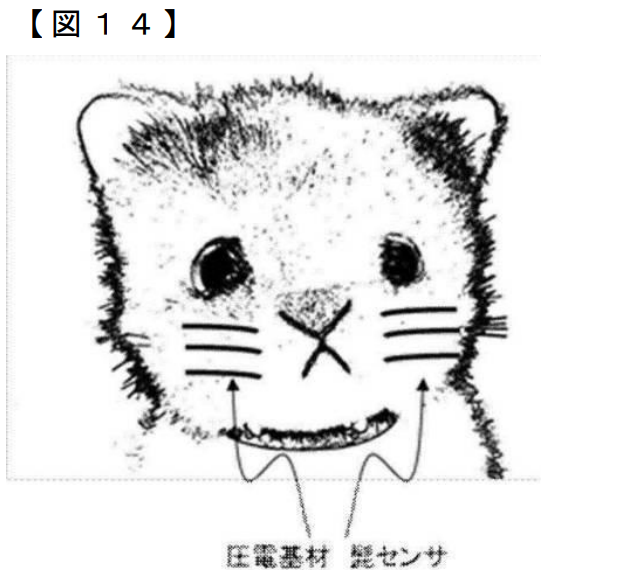
The drawing highlights a compact robotic structure featuring:
- A cat-shaped body with articulated head and limbs
- Touch or pressure sensors embedded in the head, back, or tail
- Motion or infrared sensors for detecting nearby activity
- A central control unit interpreting sensor input
- Sound or movement actuators enabling responsive expressions
The design allows the toy to behave in charming, cat-like ways.
How the Sensor-Based Interaction System Works
The robotic toy reacts to environmental cues through sensor coordination:
- Touch sensors trigger purring motions or tail movement
- Motion sensors detect approach and make the toy “greet” the user
- Light or proximity sensors help it navigate or react to gestures
- The control unit determines appropriate responses
- Emotional cues such as sounds or vibrations enhance realism
The toy mimics intuitive feline reactions.
Benefits for Children, Elderly Users, and Interactive Design
- Provides comfort and emotional companionship
- Engages children through lifelike responses
- Supports therapeutic or relaxation applications
- Ideal for educational robotics or coding programs
- Encourages gentle touch and empathetic interaction
It blends robotics with emotional design.
Engineering and Safety Considerations
Key design elements include:
- Soft external materials for safe handling
- Low-noise actuators to avoid startling users
- Efficient sensor placement to maintain balance
- Durable structure to withstand repeated play
- Low-power electronics for long-term operation
A careful balance of expressiveness and durability is required.
Patent Attorney’s Thoughts
Emotion emerges through interaction.
By giving this feline robot the ability to respond to touch and presence, the invention turns a simple toy into a gentle companion—one that mirrors the warmth and curiosity of a real cat.
Application of the Technology: Autonomous Emotion-Reflective Companion Entities and Ambient Sensing Micro-Creature Systems
Original Key Points of the Invention
- A cat-like robotic toy equipped with sensors detecting touch, proximity, or movement.
- It reacts with behaviors such as meowing, posture changes, or simple motions.
- The robot simulates emotional responses through basic input–output loops.
- Designed as an interactive companion for children or pet-like engagement.
Abstracted Concepts
- Embedding emotional responses into small autonomous bodies.
- Sensors converting environmental stimuli into symbolic “life-like” behavior.
- A miniature entity whose personality emerges from simple feedback loops.
- Physicalized emotion modeling in a compact companion device.
Transposition Target
- Micro-companion entities that reflect the user’s inner emotional landscape, adjusting their behavior to environmental, social, and psychological cues rather than simple touch or motion.
Concrete Realization
Tiny creature-like devices inhabit a user’s desk, room, or wearable space.
They sense emotional signals—voice tension, micro-expressions, gesture speed, ambient noise, and interpersonal distance.
When the user is anxious, they curl up or retreat; when the user is joyful, they roam energetically; when the user is reflective, they sit beside them and quietly glow.
Each creature becomes a living emotional indicator: a small being that externalizes inner states.
The cat robot evolves into an ambient micro-companion ecosystem—an emotional mirror that moves, behaves, and exists as a physical extension of the user’s interior world.
↓Related drawing↓