
- Introduction: Why Study the Structure of Turn-Based RPG Battle Interfaces?
- What the Patent Drawing Reveals About the Interface Layout
- How the Turn-Based Control System Operates
- Benefits for Game Designers and Players
- Engineering Considerations
- Patent Attorney’s Thoughts
- Application of the Technology: “Modular Turn-Based Battle UI Platform”
- Final Reflections
Introduction: Why Study the Structure of Turn-Based RPG Battle Interfaces?
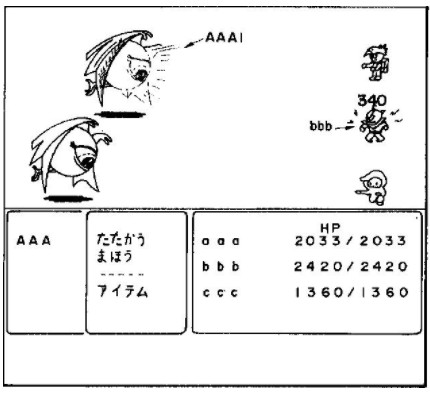
Turn-based battles are at the heart of many classic RPGs. Their interfaces must balance clarity, strategy, and immersion—allowing players to plan actions while understanding the battlefield at a glance. This patent drawing presents a turn-based battle interface layout, revealing how commands, character data, and enemy visuals can be arranged for maximum usability and emotional impact.
What the Patent Drawing Reveals About the Interface Layout
The illustration highlights a well-organized and intuitive interface structure:
- A command menu placed in a consistent, easy-to-reach location
- Character panels showing HP, MP, conditions, and turn order
- Enemy visuals centered or prominently displayed
- Action feedback area for damage, status effects, and animations
- Optional mini-icons or gauges for tactical information
The layout ensures that players always know what is happening and what their options are.
How the Turn-Based Control System Operates
The interface manages battle flow through sequential decision-making:
- Player selects a command (attack, skill, item, defense, etc.)
- The system displays targetable enemies or allies
- Actions are executed with corresponding animations
- Damage and status results appear in the feedback area
- The UI updates turn order and resource values
- The cycle repeats with clear visual guidance
This structured flow preserves strategy while remaining accessible.
Benefits for Game Designers and Players
- Provides an intuitive command structure for new players
- Supports complex strategies through clear information layout
- Enhances immersion with readable animations and feedback
- Reduces confusion in multi-character battles
- Offers modularity for future expansion (skills, party size, etc.)
The interface becomes a strategic stage rather than simple menus.
Engineering Considerations
Key factors in designing such an interface include:
- Legibility across screen sizes and resolutions
- Efficient rendering of animations and UI transitions
- Input responsiveness for both controllers and touch devices
- Memory management for layered UI systems
- Allowing customization without breaking readability
A well-made battle UI is a balanced blend of art, design, and engineering.
Patent Attorney’s Thoughts
Interfaces are the language between player and world.
A turn-based battle screen, when thoughtfully arranged, becomes more than a menu—it becomes a map of possibilities, a stage for decisions, and a rhythm that guides the player’s imagination.
Application of the Technology: “Modular Turn-Based Battle UI Platform”
Purpose
To provide an organized interface for turn-based RPG combat, supporting clear decision-making and strategic depth.
System Components
- Command selection menu
- Character status panels
- Enemy display zone
- Action feedback area
- Turn-order indicators
Operational Flow
- Display commands and status information.
- Player selects an action.
- Targets are shown and chosen.
- Action executes with visual feedback.
- UI updates resource values and next turn.
Final Reflections
This UI design refines the battle experience—not by adding complexity, but by making strategy feel natural and inviting.
Disclaimer: This content is an AI-generated reinterpretation based on a patent drawing.
It is provided for educational and cultural purposes only, and not as legal advice.
↓Related drawing↓