- Introduction: Improving Baseball Swing Form Through Natural Sensation
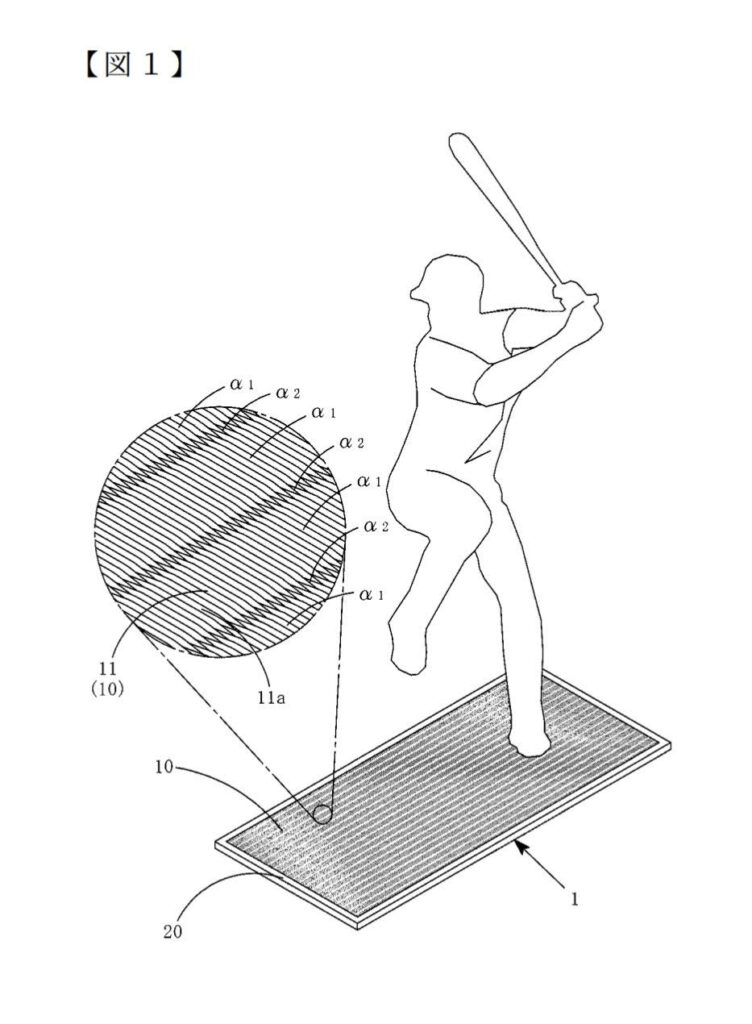
- What the Patent Drawing Shows
- How the Training Mat Enhances Swing Mechanics
- Benefits for Baseball Training and Athlete Development
- Engineering & Sports-Training Considerations
- Patent Attorney’s Thoughts
- Application of the Technology: Sensory-Driven Kinetic Feedback Terrain for Human–Environment Co-Training Systems
Introduction: Improving Baseball Swing Form Through Natural Sensation
Barefoot batting practice helps players feel their stance, balance, and weight shift more directly.
This patent drawing introduces an igusa (rush grass) woven swing-training mat designed to improve batting form through tactile feedback and stable footing, offering a natural training surface ideal for both beginners and serious athletes.
What the Patent Drawing Shows
The diagrams present a structured tatami-like mat featuring:
- Igusa woven surface offering non-slip friction for barefoot practice
- Marked foot-position zones indicating stance width and foot angle
- A central swing-axis guide to help players maintain hip alignment
- Reinforced edges preventing curling during repeated training
- A stable base layer designed to absorb impact and prevent slipping
The mat combines traditional material with modern training logic.
How the Training Mat Enhances Swing Mechanics
The barefoot design increases sensory feedback:
- Igusa texture tells players when their weight is uneven
- Foot-marking zones teach proper stance width
- Swing-axis markers guide hip rotation and shoulder alignment
- Stable grip prevents sliding during full swings
- The mat helps correct bad habits by revealing foot misplacement
It is a feedback-driven training surface.
Benefits for Baseball Training and Athlete Development
- Helps visualize and correct swing fundamentals
- Ideal for indoor training, small spaces, and home practice
- Suitable for youth players learning basic form
- Enhances proprioception—awareness of balance and pressure
- Can be combined with swing sensors or coaching tools
A simple mat becomes a coach for the lower body.
Engineering & Sports-Training Considerations
- Igusa fibers must maintain friction even when slightly damp
- Base thickness balances stability with cushioning
- Foot markers require high durability against rubbing
- Anti-slip backing prevents movement on indoor flooring
- Mat must roll or store easily without deforming
Material science supports athletic training.
Patent Attorney’s Thoughts
Training begins at the ground.
By turning natural texture into a guide for balance and form, this invention reminds us that technique is learned not only through motion, but through feeling.
Application of the Technology: Sensory-Driven Kinetic Feedback Terrain for Human–Environment Co-Training Systems
Original Key Points of the Invention
- A woven igusa mat designed to be used barefoot during batting practice.
- The texture provides tactile feedback to help users adjust stance, weight shift, and swing balance.
- Surface patterns guide foot placement and correct rotational movement.
- The mat acts as a proprioceptive coach, improving form without external instruction.
Abstracted Concepts
- Using textured terrain to modulate bodily awareness and movement precision.
- Embedding training cues into environmental surfaces rather than screens or instructors.
- Guiding kinetic learning through tactile micro-feedback.
- Enhancing performance by turning the ground itself into a teaching device.
Transposition Target
- A “kinetic feedback terrain” system: smart, textured surfaces that train posture, balance, emotional grounding, or cognitive flow simply by being stepped on or interacted with.
Concrete Realization
A modular terrain ecosystem—woven, molded, or printed—forms micro-topographies: ridges for focus, spirals for balance, wave textures for grounding.
Each terrain influences the user’s neural and muscular patterns.
Walking across the surface slowly shifts emotional tone (calm, alertness, creativity) by altering foot pressure patterns and sensory flow.
The user trains not by doing exercises, but by inhabiting a landscape that gently rewires posture, rhythm, and presence.
The mat becomes an environment that reshapes human movement and cognition simultaneously.
Disclaimer: This content is an AI-generated reinterpretation based on a patent drawing.
It is provided for educational and cultural purposes only, and not as legal advice.
↓Related drawing↓