

- Introduction: Turning Breath Into Motion Through Playful Engineering
- What the Patent Drawing Shows
- How the Air-Activation Mechanism Works
- Benefits for Play, Education, and Mechanical Learning
- Engineering & Safety Considerations
- Patent Attorney’s Thoughts
- Application of the Technology: “Air-Driven Interactive Toy Motion System”
- Final Reflections
Introduction: Turning Breath Into Motion Through Playful Engineering
This patent introduces a whimsical yet cleverly engineered mechanical toy activated by a blowgun.
By channeling a puff of air into a targeted mechanism, the user triggers a physical reaction—such as launching a figure, spinning a component, or activating a spring-loaded movement.
The toy transforms simple breath pressure into motion, blending physics, play, and interactivity.
What the Patent Drawing Shows
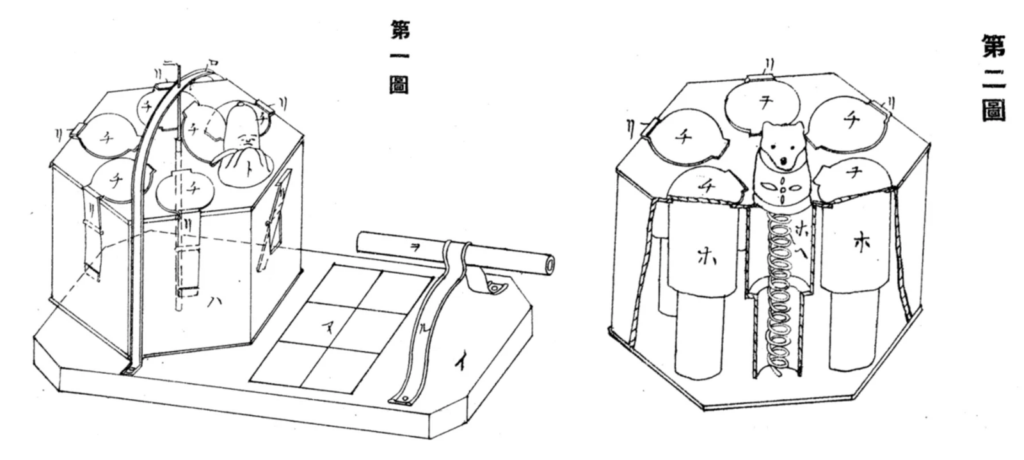
The diagrams depict a compact toy structure featuring a blow-receiving nozzle connected to an internal transmission mechanism.
When air enters the nozzle, it pushes a lightweight flap or piston, which then transfers force to gears, levers, or rotating components.
The toy’s exterior often displays a character, animal, or humorous figure whose movement becomes the visible “result” of the air-triggered action.
A stabilizing base, airflow channel, and safety-designed inlet complete the mechanism, making it accessible to children while preventing overpressure.
How the Air-Activation Mechanism Works
When the user blows into the toy’s blowgun or tubing, the air stream enters the nozzle and impacts the internal actuator.
This actuator converts air pressure into directional force, engaging a series of mechanical parts: a lever may rise, a character may jump, a rotor may spin, or a spring mechanism may snap into motion.
Because breath-pressure is gentle yet consistent, the system is designed to amplify the small input and produce a visible, entertaining output.
The toy operates without electricity, relying solely on airflow dynamics and clever mechanical amplification.
Benefits for Play, Education, and Mechanical Learning
By demonstrating how air-pressure triggers movement, the toy offers hands-on exposure to basic physics.
Children can observe cause and effect, understand force transmission, and experiment with airflow strength.
For entertainment, the toy adds tension and anticipation—each blow results in a delightful motion or comedic reaction.
It also supports safe, low-energy play, removing the need for batteries or electronic components.
Engineering & Safety Considerations
Air pathways must remain smooth and unclogged to maintain consistent airflow.
The actuator must be lightweight and responsive to minimal breath pressure, while gears require balanced friction to avoid jamming.
Safety features—such as wide-mouthed nozzles and non-detachable small parts—are essential to prevent choking hazards.
Structural stability ensures the toy remains upright when activated, and materials must withstand repeated impacts without degrading.
Patent Attorney’s Thoughts
Play happens in the instant breath becomes motion.
This invention celebrates the simplicity of cause and effect—reminding us that delight often comes from the smallest forces meeting clever design.
Application of the Technology: “Air-Driven Interactive Toy Motion System”
Purpose
To create playful mechanical motion using breath-activated air pressure.
System Components
- Blow-receiving nozzle
- Internal actuator (flap or piston)
- Gear and lever assembly
- Character or motion-output structure
- Safety-stabilized base
Operational Flow
- User blows air into the nozzle.
- Air pressure activates internal actuator.
- Actuator transfers force to gears or levers.
- External character or mechanism moves.
- System resets automatically for repeated play.
Final Reflections
This air-powered toy showcases how simple mechanics can spark joyful interactions—turning breath into a miniature moment of motion and surprise.
Disclaimer: This content is an AI-generated reinterpretation based on a patent drawing.
It is provided for educational and cultural purposes only, and not as legal advice.
↓Related drawing↓