

In this article, we introduce a patent related to a Tamagotchi digital pet interface, focusing on how user interaction elements are translated into a technically structured and engaging interface design.
- Introduction: A Nostalgic Yet Innovative Digital Pet Interface
- What the Patent Drawing Shows
- How the Digital Pet Interaction Works
- Benefits for User Engagement and Game Design
- Engineering & Interaction Design Considerations
- Patent Attorney’s Thoughts
- Application of the Technology: Emotional-State-Responsive Micro-Cosmos Interface Systems
Introduction: A Nostalgic Yet Innovative Digital Pet Interface
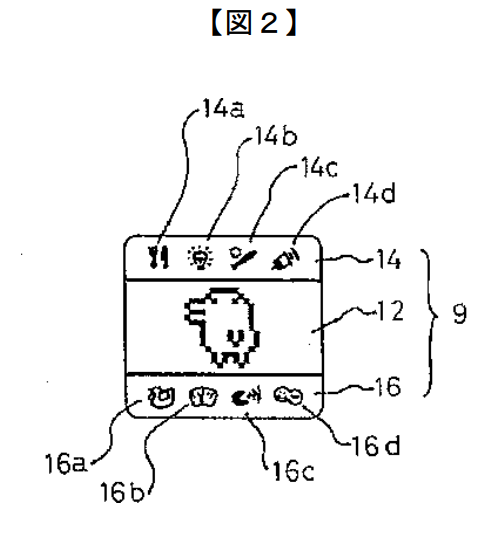
The Tamagotchi phenomenon defined an era of handheld digital play. This patent drawing reveals the structure and interaction model behind a digital pet interface, capturing the essence of nurturing, monitoring, and responding to a virtual creature.
What the Patent Drawing Shows
The interface structure includes:
- A pixel-based character display
- Interaction buttons arranged for simple thumb control
- Status indicators showing hunger, happiness, and health
- Behavioral response icons tied to user input
- A compact housing optimized for handheld continuous play
Its simplicity is part of its charm—intuitive, small, and emotionally engaging.
How the Digital Pet Interaction Works
Users send inputs through three primary buttons.
The system interprets these commands as feeding, cleaning, playing, or discipline.
The virtual pet’s state changes based on time and user responses.
When neglected, indicators decline, prompting the user to respond.
The cycle creates a bond between player and digital companion.
Benefits for User Engagement and Game Design
- Creates emotional attachment through simple feedback loops
- Encourages repeated short-interval engagement
- Easy-to-learn interface suitable for all ages
- Ideal for handheld or wearable devices
- Provides a flexible foundation for future virtual pet systems
Tamagotchi-style interfaces still influence mobile gaming today.
Engineering & Interaction Design Considerations
- Pixel density and refresh rate must support expressive animations
- Buttons must be durable for repeated pressing
- Low-power consumption ensures long-term portable play
- Audible feedback enhances responsiveness
- Character states require balanced timing algorithms
The design harmonizes minimalism with emotional expressiveness.
Patent Attorney’s Thoughts
A small screen, a few buttons, and a fragile pixelated life—that simplicity becomes a doorway to imagination. This invention shows how emotional connection can grow from the lightest touch of design.
Application of the Technology: Emotional-State-Responsive Micro-Cosmos Interface Systems
Original Key Points of the Invention
- An interface for a digital pet that displays multiple states: hunger, mood, sickness, interaction prompts.
- A small screen cycles between simplified symbolic icons and real-time status updates.
- User actions—feeding, cleaning, playing—directly influence the creature’s state.
- A closed-loop system where digital life responds to human-triggered inputs.
Abstracted Concepts
- A micro-ecosystem with feedback loops linking user actions and system states.
- Symbol-based communication between human and artificial lifeforms.
- A compact “universe container” with its own logic, needs, and progression.
- Managing emotional or existential states through minimalistic interfaces.
Transposition Target
- A pocket-sized “emotional micro-cosmos” that represents the user’s inner psychological state as a living entity, reacting to thoughts, behaviors, and surroundings.
Concrete Realization
A small wearable device hosts a symbolic lifeform that mirrors the user’s inner conditions.
Stress increases? The creature becomes cloudy.
Calm focus? It crystallizes into geometric harmony.
Social warmth? It sprouts constellations.
The system uses biometric readings, voice tone, and environmental cues to evolve the micro-cosmos.
Instead of caring for a pet, the user cares for their own interior world—visible, reactive, and poetic.
A Tamagotchi-like interface becomes a living map of consciousness.
↓Related drawing↓